
Our Unified Agentic Framework is purpose-built for hospitals, labs, and revenue cycle teams who rely on ADT feeds, HL7 messaging, DICOM workflows, and 837 claims data. By integrating these disparate streams through rigorous clinical validation and interoperability, we deliver the evidence-based reliability needed to turn fragmented signals into mission-critical foresight across:

ADT Patient Movement & Flow

LIS Laboratory Workflows
PACS / RIS Imaging Systems

Billing & RCM Platforms

SNOMED Terminology

HCPCS / Procedure Codes
Healthcare Use Cases
Each Prajna AI capability is validated through high-fidelity simulations designed to reflect real healthcare operating conditions.

From Encounter Records to Early Clinical Signals: Transforming Care Pattern Visibility with AINalyzer
At a Glance
A healthcare analytics solution designed to convert structured encounter data into clinically meaningful insight.
AINalyzer enables hospitals and health systems to identify disease progression patterns, delayed diagnosis risks, geographic access effects, and emerging capacity pressures — using existing clinical and administrative data sources.
The system helps teams understand how care actually unfolds across visits, specialties, and time.

Operational Challenge
Despite capturing large volumes of encounter and diagnosis data, hospitals struggled to answer practical questions:
- EHR / claims data optimized for reimbursement, not intelligence
- Fragmented longitudinal patient record visibility
- Unquantified access-to-care disparities
- Unmodeled comorbidity & disease trajectories
- Retrospective utilization-based demand planning
- Non-standardized cross-system benchmarking
Reporting systems described activity but did not explain behavior.
Solution
AINalyzer introduced progression-aware analytics across encounter datasets:
- Standards-native analyticsHL7 FHIR®, HL7 v2, and X12 claims enabling longitudinal care modeling
- Discovery of high-frequency clinical pathways and progression risks from FHIR Encounter / Condition / Procedure sequences
- Encounter-normalized, risk-adjusted benchmarking across multi-facility, multi-EHR environments
- Conversion of HL7 v2 ADT and FHIR event streams into predictive capacity and demand signals
- Quantification of geospatial access inequities using FHIR Location / Encounter origin data
- Foundation for population-scale predictive and prescriptive health system models
Care patterns become visible instead of retrospective.
Observed Outcomes
- 12% of conditions drove 68% of downstream procedures
- Top progression chains linked to 74% of high-acuity readmissions
- Patients traveling >25 miles showed 31% higher late-stage diagnoses
- Capacity forecasts reached 89% accuracy at 30-day horizon
- Previously untracked comorbidity pairs surfaced
Hospitals gained earlier visibility into deterioration and pressure signals.

From Visual Observation to Measured Flow: Improving Throughput Visibility with VisionIQ
At a Glance
A privacy-preserving computer vision system designed to quantify patient flow, room utilization, and congestion dynamics using existing camera infrastructure
Operational Challenge
Facility operations relied heavily on estimation:
- Unmeasured throughput latency across patient flow stages
- Manual room & resource status tracking causing idle capacity
- Heuristic-based staffing vs encounter-driven demand patterns
- Fragmented operational data capture / analytics silos
- Analytics vs patient privacy constraints (HIPAA / PHI exposure risk)
- Uneven room & asset utilization without performance visibility
Capacity inefficiencies remained hidden.
Solution
VisionIQ introduced objective operational measurement:
- FHIR®-driven room & chair visibility improving throughput
- FHIR Encounter–based wait-time analytics eliminating guesswork
- Detection of capacity & load imbalances across care zones
- HL7 v2 ADT–informed staffing optimization
- HIPAA-compliant, privacy-preserving edge analytics data
- Improved asset utilization & appointment yield
Hospitals gain measurable flow signals without PHI exposure.
Observed Outcomes
- Fully automated patient flow capture — zero manual data entry
- Sub-second room & zone state updates (<1s latency)
- High-precision wait-time measurement across care zones
- Zero PHI / biometric identity persistence — anonymous tracking only
- Throughput uplift potential (10–15%) via turnover optimization
- Hourly demand & traffic pattern visibility
- Noise-filtered encounter detection (minimum dwell threshold)
Passive infrastructure became an intelligence source.

From Contract Interpretation Variability to Structured Validation: Improving Compliance Consistency with DocuLens
Operational Challenge
Contract reviews created administrative delays:
- Clause-by-clause manual validation
- Missing requirement exposure risks
- Reviewer-dependent interpretations
- Slow correction cycles
- Limited structural visibility
Solution
DocuLens standardized contract validation:
- Standards-aware analysis compatible with 837 claims, HL7 messaging artifacts, ICD-10, SNOMED CT, HCPCS
- Automated structural parsing & chunking across heterogeneous healthcare documents
- Searchable semantic indexing for rapid clinical, billing, and policy interrogation
- Reference-standard deviation detection (missing codes, clauses, structural anomalies)
- Weighted compliance & conformity scoring for objective evaluation
- Structured, audit-ready reporting supporting payer, provider, and regulatory workflows
Observed Outcomes
- Reduced manual review effort
- Faster identification of missing clauses
- Clear visibility into structural misalignment
- Objective scoring across document sets
- Improved audit preparedness
Most importantly, it shifted document validation from subjective review to structured compliance intelligence.

From Equipment Specifications to Deterministic Performance Validation: Strengthening Engineering Decisions with DocuDigest
At a Glance
A deterministic reasoning system designed to interpret equipment manuals, safety constraints, and operating specifications for healthcare engineering and facility planning teams.
Operational Challenge
Equipment evaluation required expert interpretation:
- Fragmented device / equipment data sources
- Table-driven estimates vs dynamic modeling
- Missing dependency-aware system context
- Limited cross-asset benchmarking
- Unvalidated safety & constraint rules
- SME-dependent operational analysis
- No explainable decision reasoning
Constraint:
Systems computed values but lacked contextual validation.
Solution
DocuDigest introduced deterministic equipment intelligence:
- Standards-aware knowledge ingestion across EHR, CMMS, and document repositories (HL7®, FHIR®, device manuals, SOPs)
- Deterministic + AI reasoning layer for device performance, utilization, and constraint-aware analysis
- Automated safety & regulatory compliance validation (OEM limits, accreditation, operational thresholds)
- Cross-device benchmarking & utilization intelligence across imaging, diagnostic, and therapeutic assets
- Explainable decision support for biomedical, clinical engineering, and operations teams
- Structured, audit-ready reporting supporting regulatory, quality, and governance workflows
Answers remain traceable to source documentation.
Observed Outcomes
- Engineering assessment time reduced
- Safety validation confidence improved
- Equipment comparisons standardized
- Expert dependency lowered
- Decision repeatability strengthened
The Prajna AI Edge
Healthcare environments demand reliability, not speculation.
PrajnaAI Agentic Framework is designed for decision-critical contexts.

Control Layer
Standards-Aligned Data Intake

Intelligence Layer
Deterministic Clinical Reasoning

Execution Layer
Workflow-Safe Operational Intelligence

Governance Layer
Compliance-Safe & Audit-Defensible

Presentation Layer
Clinician-Readable Intelligence
From Reactive Interpretation to Predictive Visibility
| Traditional Environments | With Prajna AI |
|---|---|
| Retrospective reporting | Predictive system signals |
| Hidden operational pressure | Early strain detection |
| Manual interpretation burden | Structured intelligence workflows |
| Fragmented visibility | Unified decision support |
| Reactive adjustments | Planning stability |
Engage Without Disruption
Prajna AI solutions are designed to operate alongside your current systems.
- Time-consuming compound screening
- Inefficient molecular property prediction
- Challenges optimizing clinical trial sites
- Difficulty synthesizing vast biomedical knowledge
- Manual and error-prone data analysis
- Slow and costly clinical trial processes
Key Pain Points:
- GrasPh
- DocuDigest
- DocGenetiX
Our Solutions
- Shorten R\&D cycles and improve clinical outcomes with AI-powered drug discovery platforms. Our system identifies promising compounds, predicts molecular efficacy, and optimizes trial site selection—enhancing precision medicine while reducing research costs and timelines.
Our Solution offers:
- Slow adverse event detection
- Inconsistent regulatory document formats
- Challenges monitoring evolving labeling compliance
- Risk of non-compliance and penalties
- Manual review of vast regulatory data
Key Pain Points:
- DocuDigest
- DocGenetiX
- VisionIQ
Our Solutions

- Ensure seamless regulatory compliance with AI-enabled monitoring and reporting tools. Our solutions automate adverse event detection, streamline submission workflows, and highlight labeling gaps—minimizing regulatory risks and improving pharmacovigilance efficiency.
Our Solution offers:
- Difficulty reaching target audiences effectively
- Inaccurate supply chain demand forecasting
- Difficulty adapting to market changes
- Manual data analysis for commercial insights
Key Pain Points:

- AutoInsight
- AINalyzer
- Grasph
Our Solutions
- Boost market performance with AI-enhanced sales optimization tools. Our platform delivers real-time insights into demand, inventory, and field performance—helping life sciences companies adapt faster to market changes and improve commercial outcomes.
Our Solution offers:
- Tedious manual literature review
- Difficulty identifying influential Key Opinion Leader (KOLs)
- Challenges performing comprehensive post-market safety analysis
- Slow generation of real-world evidence
- Lack of real-time insights from vast medical literature
Key Pain Points:
- AutoInsight
- VisionIQ
- AINalyzer
- DocuDigest
Our Solutions

- Empower medical affairs teams with AI solutions for rapid evidence synthesis and KOL engagement. Our tools extract insights from scientific literature, monitor safety signals, and support post-market research—enabling informed decisions and regulatory alignment.
Our Solution offers:
- Manual and time-consuming radiology interpretation
- Challenges with large-scale pathology slide analysis
- Limited bedside diagnostic support
- Potential for human error in image analysis
- Slow turnaround times for critical diagnoses
Key Pain Points:

- ImaGenetiX
- VizAIo
- GrasPh
Our Solutions
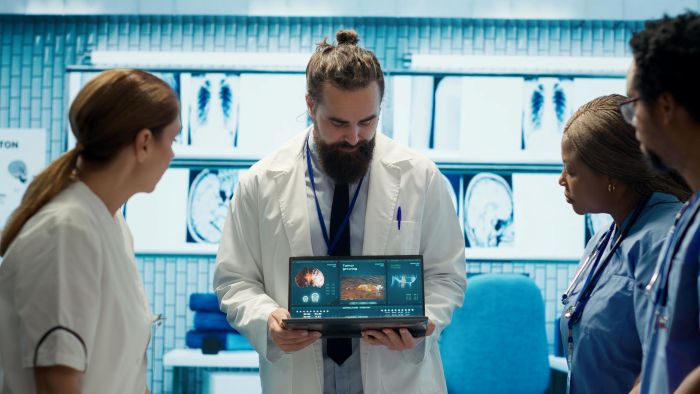
- Improve diagnostic accuracy and speed with AI-powered medical imaging analysis. Our system supports radiology, pathology, and point-of-care diagnostics—reducing errors and accelerating clinical decisions across a variety of healthcare settings.
Our Solution offers: