
From Reactive Fixes to Proactive Resilience: Optimizing Risk Mitigation
Introduction: The New Age of Intelligent Logistics
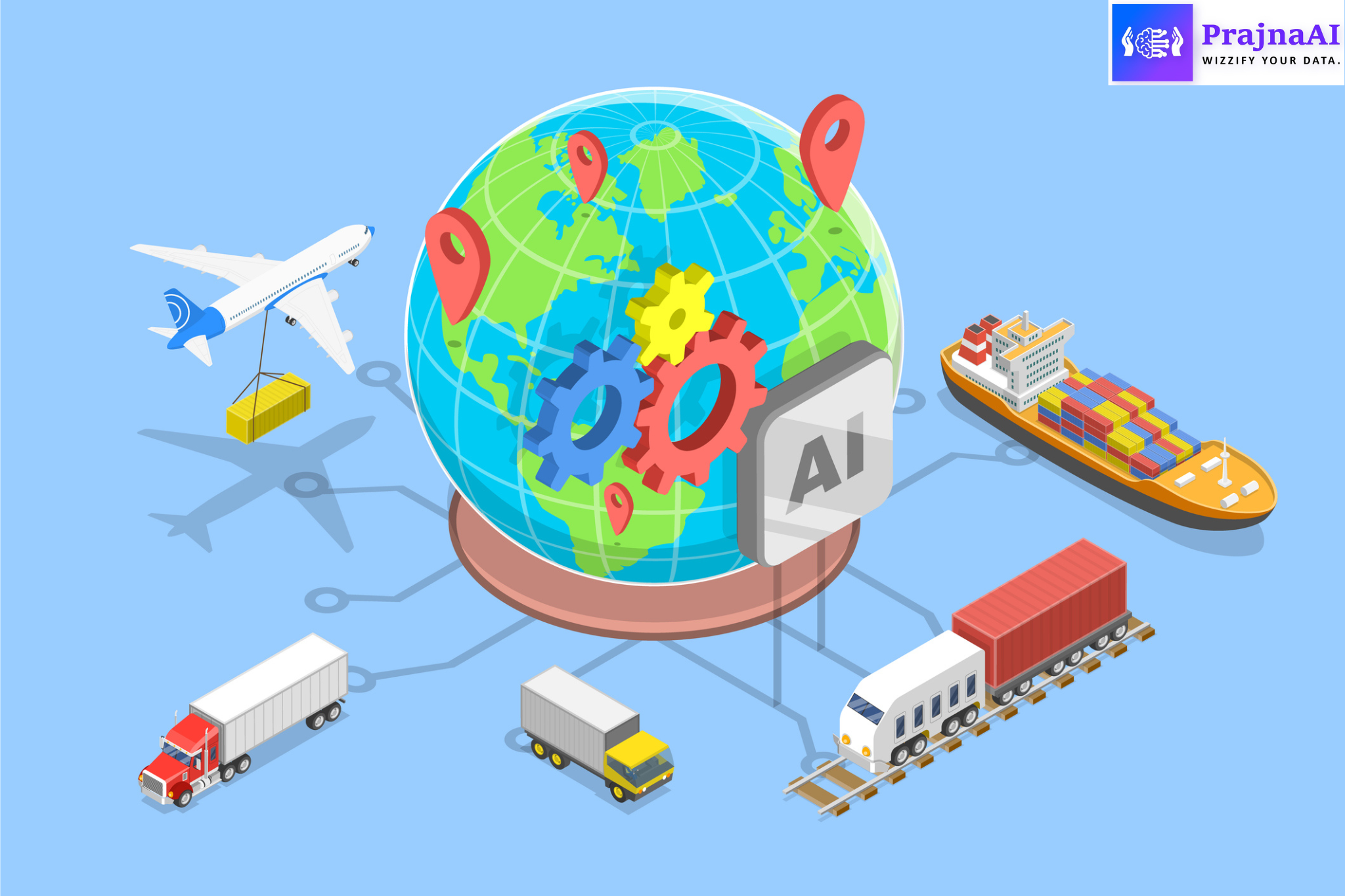
The contemporary global logistics landscape is defined by stochastic volatility across multiple exogenous variables (geopolitical events, trade policy shifts, climate phenomena). Traditional rule-based planning (MRP/DRP) and linear optimization models exhibit insufficient robustness under these conditions. Enterprise organizations are transitioning to a Cognitive Supply Chain (CSC) paradigm, leveraging Artificial Intelligence (AI) to enable end-to-end network intelligence, hyper-optimization, and autonomous operational resilience. This architecture is predicated on the synergy between low-latency IoT data streams, high-fidelity Digital Twin simulations, and Deep Learning (DL) powered Predictive Analytics.
1. Architectural Mandate: Shifting the Objective Function
The primary shift in Supply Chain Management (SCM) strategy is the re-prioritization of the objective function from pure Cost Minimization (min(C)) to Risk-Adjusted Throughput Maximization (max(T∣R)). This requires an architecture capable of:
- Non-linear Optimization: Utilizing heuristic and metaheuristic algorithms (e.g., genetic algorithms, reinforcement learning) to navigate vast solution spaces defined by complex constraints.
- Continuous Process Learning: Implementing adaptive models that update parameters (θ) based on real-time operational feedback loops.
- Accelerated Decision Velocity: Reducing the latency between anomaly detection and response execution through edge and federated learning mechanisms.
- Digital Twinning & Simulation: Creating a persistent, real-time virtual representation for zero-risk scenario planning and policy evaluation.
2. Digital Twins: The Real-Time Physics Engine
The Supply Chain Digital Twin (SC-DT) is a dynamic, high-fidelity computational model instantiated across the entire logistics network. It serves as the single source of truth for network topology and asset state.
- Data Ingestion Pipeline: Requires aggregation and harmonization of disparate data sources: low-latency telemetry from IoT sensors (MQTT/AMQP), high-latency structured data from ERP(Enterprise Resource Planning)/WMS(Warehouse Management System)/TMS(Transportation Management System) systems (API/ETL), and unstructured external data (web scraping/NLP).
- Simulation Core: Utilizes discrete event simulation (DES) or agent-based modeling (ABM) engines to process “what-if” scenarios (Si) against the current network state (Ψt).
- AI Augmentation: Machine Learning (ML) models are employed to validate simulation outcomes and suggest optimal policy adjustments (P∗) by analyzing the historical divergence between simulated results and real-world execution metrics (ϵ).
- Predictive Maintenance (PdM): DTs incorporate high-frequency sensor data (e.g., vibration, thermals) to execute Remaining Useful Life (RUL) modeling via techniques like auto-regressive models on equipment critical path assets.
3. Predictive Analytics: Deep Learning for Foresight
Predictive Analytics transforms ingested data into actionable foresight via advanced statistical and Deep Learning methodologies.
- Time Series Forecasting (Demand/Lead Time): Implementation relies heavily on Long Short-Term Memory (LSTM) or Gated Recurrent Unit (GRU) Neural Networks to capture long-range temporal dependencies. Feature engineering incorporates exogenous variables (macroeconomic indicators, seasonality Fourier terms, promotional lift indices) to improve forecast accuracy (ρ).
- AI-Driven Risk Quantification: Graph Neural Networks (GNNs) are increasingly utilized to model complex supplier interdependence and assess cascading failure probability. Inputs include financial disclosures, geopolitical event streams (leveraging Named Entity Recognition/NLP), and ESG scoring metrics to derive a composite risk score for each node (Rj).
- Logistics Flow Optimization: Spatiotemporal data (route history, congestion) is processed via Convolutional Neural Networks (CNNs) combined with LSTMs to predict transit delay distributions and dynamically adjust the Estimated Time of Arrival (ETA) with a confidence interval.
4. IoT and Edge Computing: The Low-Latency Data Layer
The fusion of IoT with AI establishes the essential closed-loop control system, enabling instant detection and autonomous response.
- Real-Time Data Acquisition: Assets are instrumented with sensors providing telemetry (location, temperature, shock, acceleration). Data transmission often adheres to low-power protocols (LoRaWAN, Zigbee) and is aggregated via protocols like MQTT for low-overhead ingestion.
- Edge Processing & Inferencing: Simple ML models (e.g., anomaly detection classifiers) are deployed to the Edge/Gateway layer to perform preliminary inferencing locally, significantly reducing backhaul bandwidth requirements and minimizing control loop latency (tL).
- Self-Healing Mechanisms: AI systems interpret edge-processed events and automatically trigger pre-defined policy responses (e.g., dynamic re-routing of a shipment based on predicted severe weather, adjustment of warehouse inventory pulls based on real-time inbound delays).
5. Operational Metrics and Value Realization
The strategic payoff is quantifiable through superior operational metrics and a demonstrable increase in architectural robustness:
| Metric Category | Key Performance Indicator (KPI) | Technical Impact |
| Resilience & Risk | Predicted vs. Actual Disruption Rate | Proactive mitigation and near-zero unplanned downtime (Δt). |
| Efficiency & Cost | Total Cost of Ownership (TCO) per Unit Moved | Fuel consumption optimization and reduction of labor hours through task automation. |
| Agility & Planning | Planning Cycle Time Reduction | Near-instantaneous recalculation of the Optimal Production/Distribution Plan (OPDP). |
| Compliance | Sustainability Index Score (GHG Emissions) | Minimized mileage via ML-optimized routing and predictive asset lifespan extension. |
How Prajna AI’s Solutions Address Future of Money Imperatives
Prajna AI’s solutions directly address the future of global logistics by integrating advanced Generative AI and Graph Database technologies to create an autonomous, resilient supply chain that evolves the concepts of Digital Twins and Predictive Analytics.
| Supply Chain Imperative | Prajna AI Solution | Mechanism and Impact Summary |
| Instant, Intelligent Execution | GrasPh + DocuDigest + Vision IQ integrate reasoning, validation, and execution. | Mechanism: This stack forms the core of the Agentic Architecture. GrasPh provides contextual data for rapid decision-making; DocuDigest automates the reading and interpretation of complex documents (contracts, compliance forms); and Vision IQ provides real-time monitoring and visual confirmation. Impact: Enables instant validation of compliance/risk factors, triggering autonomous execution of logistics actions (e.g., auto-releasing a container upon visual confirmation and contract validation). |
| Autonomous Agentic Workflows | Built for Agentic Architecture-driven automation. | Mechanism: Prajna AI uses intelligent AI agents uses Cypher Queries to retrieve deep contextual information from the graph, allowing them to synthesize optimal policies (Generative AI) and execute complex, multi-step workflows without human intervention. Impact: Transforms traditional, manual processes into self-healing, adaptive workflows that manage exceptions and disruptions autonomously. |
| Data-Driven Risk & Compliance | AINalyzer + AutoInsight enforce transparent governance. | Mechanism: AINalyzer applies advanced machine learning (including GNNs for relationship-based risk analysis) to all ingested data to identify anomalies and quantify cascading risk across the network. AutoInsight provides the explainability layer, ensuring decisions are traceable, auditable, and grounded in the Graph Database (GraphRAG). Impact: Shifts compliance from a periodic audit function to a continuous, proactive enforcement model, minimizing financial risk and ensuring regulatory adherence in real-time. |
| Operational Resilience & Visibility | Vision IQ adds real-time monitoring for end-to-end visibility. | Mechanism: Vision IQ provides the critical Execution Layer data, using computer vision to monitor asset condition, quality control, and logistics status (e.g., container integrity, loading accuracy). This low-latency feedback loop feeds data directly into the Digital Twin, informing the AI agents. Impact: Guarantees the fidelity of the Digital Twin and provides the agents with the necessary real-world context to perform immediate, physical-world interventions, ensuring continuous operations and high service levels |
Conclusion: Autonomous and Adaptive Systems
The future of global logistics resides in autonomous, anticipatory cyber-physical systems. By architecting solutions that deeply integrate low-latency IoT data, physics-based Digital Twins, and advanced Deep Learning models, organizations establish a self-optimizing ecosystem. Data is no longer merely descriptive; it is the control signal for a high-performance, future-proofed supply chain designed for sustained resilience against volatility.